
To increase Google reviews, small businesses must simplify the collection process through direct links, QR codes, and NFC technology, request feedback at the right time (2-3 days after purchase), respond to all received reviews, and use automated tools to manage the constant flow of feedback. Success depends on a combination of strategic request techniques, compliance with Google guidelines, and an effective monitoring system.
Key Points to Remember:
- Simplify access: Using direct links, QR codes, and NFC cards reduces technical barriers and increases customer response rates
- Strategic timing: Requesting reviews 2-3 days after purchase or service maximizes the chances of receiving positive feedback
- Always respond: Every review, positive or negative, deserves a professional and timely response to build trust
- Avoid violations: Do not offer direct incentives for positive reviews, do not buy fake reviews, and do not manipulate the system
- Automate management: Specialized platforms like aumentarecensioni.com allow you to efficiently collect, monitor, and respond to reviews
- Integrate into the business process: Incorporating the request for reviews into the daily workflow increases consistency and results
- Monitor regularly: Analyzing received reviews identifies strengths and areas for improvement for the business
- Use multiple channels: Email, SMS, printed materials, and website must work together to maximize collection opportunities
Why Google Reviews Are Essential for Your Business
Google reviews represent the main trust factor for Italian consumers looking for local products and services. When a potential customer searches for “restaurant near me” or “plumber Milan,” businesses with more positive reviews appear in privileged positions and gain greater visibility.
Reviews directly influence three critical aspects of the business:
Visibility in search results: Google rewards businesses with recent and numerous reviews by ranking them higher in local results. This means more clicks, more visits, and more potential customers.
Conversion rate: A business with 50 reviews and an average of 4.5 stars converts significantly better than a competitor with 10 reviews and 4.8 stars. Volume matters as much as quality.
Online reputation: Reviews build social credibility. Customers trust the opinions of other consumers more than any advertising message.
To delve deeper into the strategic importance of reviews, check out our complete guide to Google reviews for SMEs.
How Reviews Improve SEO Ranking
Reviews contribute to local ranking through various mechanisms. Google considers the total number of reviews, the frequency with which they are received, the variety of content, and the responses provided by the business. [1]
A constant flow of reviews signals to Google that the business is active, relevant, and appreciated by the local community. This translates into better visibility for geo-localized searches.
Learn more about how to improve your business’s SEO with reviews.
How to Increase Google Reviews: Practical Strategies
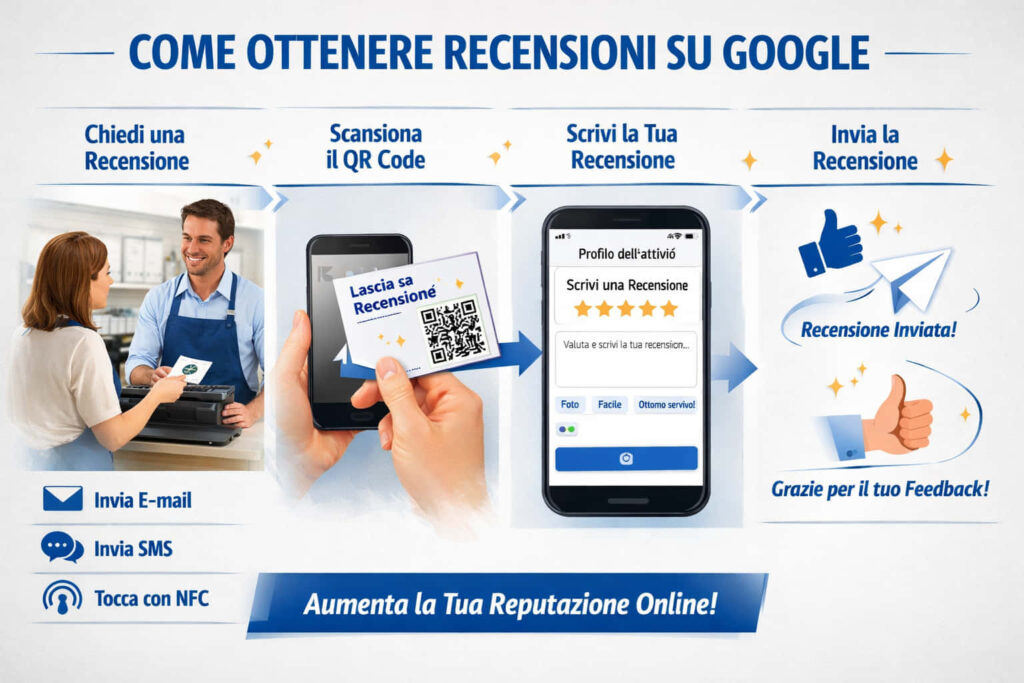
To effectively increase Google reviews, it is necessary to implement a structured system that combines technology, timing, and strategic communication. The first step is to radically simplify the process for customers.
Create a Direct Link to Your Google Business Profile
The simplest method to collect reviews is to provide customers with a direct link that takes them immediately to the review page. This eliminates the need to manually search for the business on Google.
How to create the direct link:
- Access your Google Business profile
- Go to the “Home” section of the control panel
- Click on “Get more reviews”
- Copy the automatically generated short link
- Use this link in emails, SMS, and printed materials
The short link has this format: g.page/r/[unique-code]/review
This URL can be further shortened with services like Bitly to make it more manageable in printed materials.
Use Strategically Placed QR Codes
QR codes represent a sleek solution for businesses with physical locations. They allow customers to leave a review simply by scanning the code with their smartphone camera. [1]
Strategic placements for QR codes:
- Checkout or reception: The payment moment is ideal for requesting feedback
- Restaurant tables: Place small stands with QR codes near condiments
- Windows and entrance doors: Capture the attention of customers exiting
- Delivery materials: Include the QR code on invoices, receipts, and packaging
- Waiting areas: Take advantage of customers’ downtime
To generate an effective QR code, use the direct link to the Google Business profile and free services like QR Code Generator or QR Code Monkey. Ensure the code is large enough (at least 3×3 cm) to be easily scanned.
Implement NFC Technology for Immediate Reviews
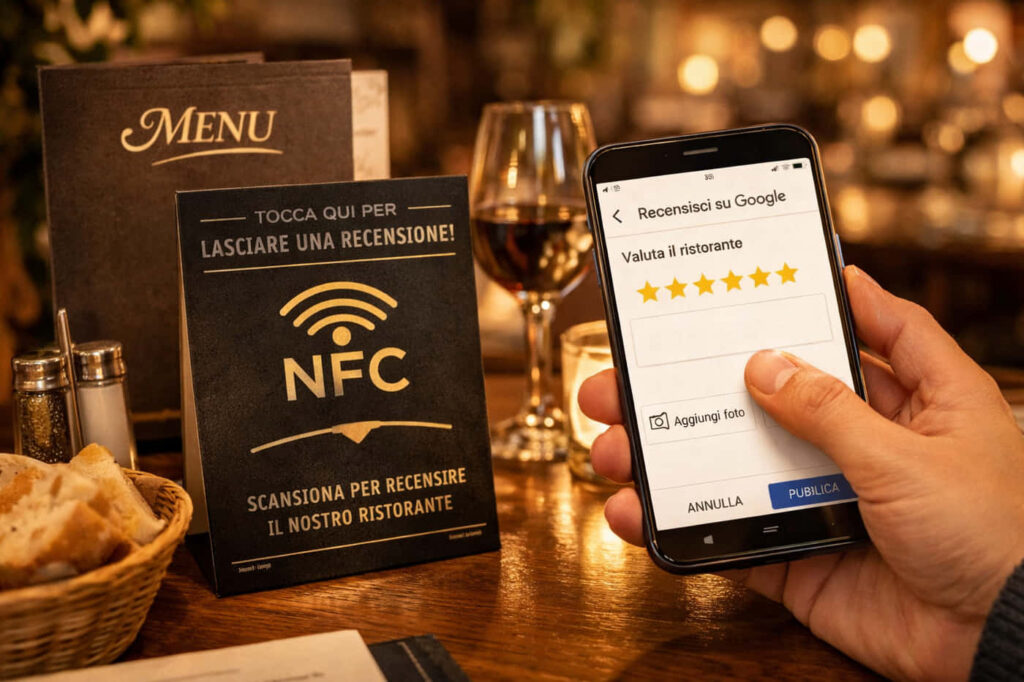
NFC (Near Field Communication) cards offer an even smoother experience than QR codes. Customers simply bring their smartphone close to the card to automatically open the review page. [2]
Benefits of NFC cards:
- Work even with locked screens on many devices
- Professional and sleek appearance
- Reusable and durable over time
- Do not require additional apps
- Superior user experience
NFC cards can be purchased online at affordable prices (around 2-5 euros per card) and programmed with the direct link to the Google Business profile. They are particularly effective for restaurants, hotels, beauty salons, and professional offices.
Targeted and Personalized Email Campaigns
Email marketing remains one of the most effective channels for collecting reviews, with significantly higher response rates compared to other methods when done correctly. [1]
Elements of an effective email campaign:
Optimal timing: Send the email 2-3 days after the purchase or service. This interval allows the customer to use the product or reflect on the experience, keeping the memory fresh.
Personalized subject: Use the customer’s name and specific references to the purchase. Example: “Marco, what do you think of your new service?”
Short and direct message: Avoid long introductions. Get straight to the point with a clear request and a prominent call-to-action button.
Mobile-friendly design: Over 60% of emails are opened on mobile devices. The button to leave a review should be large and easily clickable.
Example of email structure:
Subject: Thank you for choosing [Business Name]!

Hi [Name],

Thank you for visiting [Business Name].
Your opinion is important to us and helps other customers discover our services.

Could you take 60 seconds to share your experience?

[BUTTON: Leave a Review]

Thank you for your time!

[Signature]
How to Increase Reviews on Google While Following Guidelines
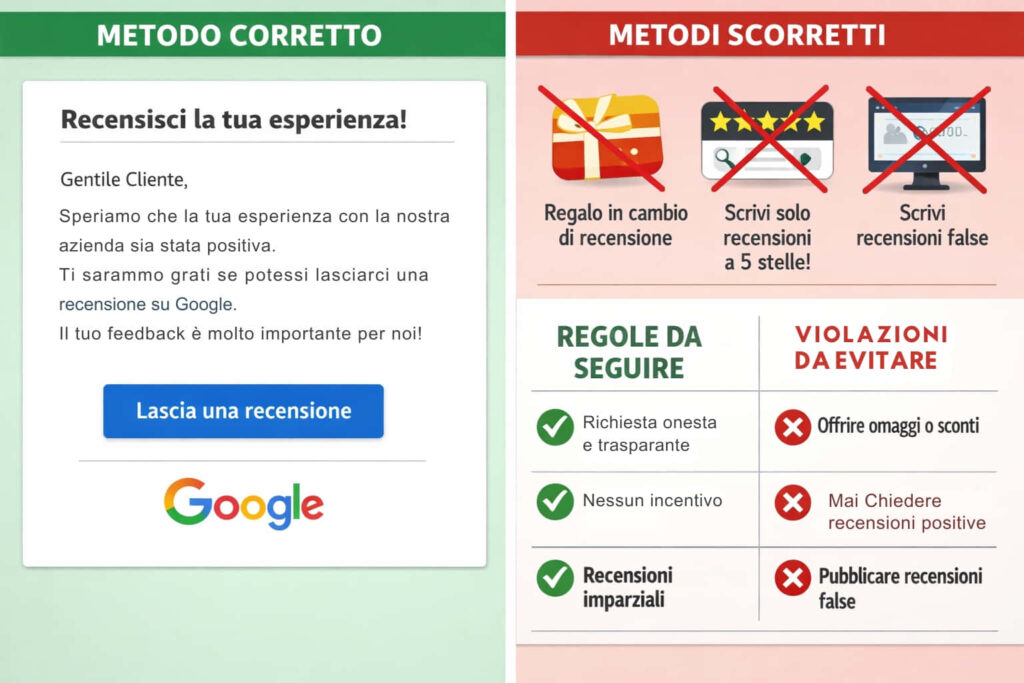
Increasing reviews on Google requires careful attention to the platform’s policies. Google enforces strict rules to maintain the integrity of the review system and severely penalizes violations. [4]
What Is Allowed and What Is Prohibited
Permitted practices:
- Request reviews from all customers impartially
- Provide direct links to the Google Business profile
- Send follow-up emails after purchase
- Display signs and materials inviting reviews
- Offer generic loyalty programs not tied to reviews
- Respond publicly to all reviews
Prohibited practices:
- Offer discounts, freebies, or incentives in exchange for reviews
- Purchase fake reviews from third-party services
- Write reviews for your own business
- Only ask satisfied customers to leave reviews
- Threaten or intimidate customers who leave negative reviews
- Create fake accounts to review your own business
- Offer rewards to employees for each review collected
Google uses sophisticated algorithms and manual reviews to identify suspicious activity. Penalties include the removal of fake reviews, lowering local ranking, and, in severe cases, suspension of the Google Business profile.
Compliant Incentives: How to Offer Them Correctly
While it is not possible to offer direct incentives for reviews, there are compliant strategies that encourage feedback without violating policies. [1]
Generic loyalty programs: Create a points system for each purchase (not for each review) that customers can accumulate over time. Casually mention that “customers who share their experience online tend to stay more engaged with our loyalty program.”
Unconditional post-review discounts: Send a discount code via email after a customer has left a review, without having promised it in advance. This spontaneous thank you does not violate guidelines because it was not conditioned on the review.
Separate contests and giveaways: Organize monthly drawings among all customers, regardless of reviews. Mention in communication that “we appreciate all feedback we receive online” without creating a direct link.
The key is to always maintain a clear separation between the incentive and the review, avoiding any language that suggests a direct exchange.
When and How to Ask Customers for Reviews
The timing of when you ask for a review dramatically influences the likelihood of receiving it and its positivity. Asking too early or too late significantly reduces response rates.
The Perfect Time to Ask
For physical products: Wait 3-5 days after delivery. This allows the customer to receive, open, and use the product at least once.
For professional services: Request within 24-48 hours of service completion, when the experience is still fresh in the customer’s memory.
For restaurants and hospitality: The ideal moment is immediately after the experience or within 24 hours. The longer you wait, the more the details of the experience fade.
For ongoing services: Request reviews after significant milestones (first month, important result achieved) rather than at random intervals.
Effective Communication Techniques
The formulation of the request determines the response rate. Generic and impersonal messages are ignored, while personalized and specific requests yield better results.
Principles of effective communication:
Authentic personalization: Refer to specific details of the interaction. “I’m glad the new electrical system meets your expectations” works better than “Thank you for choosing our services.”
Explain the impact: Help the customer understand why their review matters. “As a small local business, every review helps us get known by other customers in the area.”
Make it easy: Always include a direct link or a QR code. Never ask the customer to manually search for the business.
Be specific about time: “It only takes 60 seconds” is more effective than “when you have time” because it reduces the perception of effort required.
Avoid pressure: Phrases like “we would be grateful if…” work better than “you must…” or “it’s important that you…”
Integrate the Request into the Business Process
To achieve a steady flow of reviews, the request must become an integral part of the standard operating process, not an occasional activity.
For physical stores:
- Train staff to mention reviews at checkout
- Include a reminder on the printed receipt
- Display visible signs near the register
For home services:
- Include a card with a QR code in the materials left with the customer
- Send a thank you SMS with a direct link within 2 hours
- Follow up with a personalized email the next day
For e-commerce:
- Automate follow-up emails 3-5 days after delivery
- Include an insert in the package with clear instructions
- Create a dedicated landing page for reviews on the site
Consistency is key. A business that asks for reviews from every customer will achieve significantly better results than one that does it sporadically.
Tools and Platforms for Managing Google Reviews
Manually managing reviews quickly becomes unsustainable as volume increases. Specialized platforms automate collection, monitoring, and response, saving valuable time and improving management quality. [3]
Essential Features of a Management Platform
A professional solution for review management must offer:
Automated collection: Scheduled sending of requests via email and SMS based on specific triggers (completed purchase, service provided, milestone reached).
Centralized monitoring: A single dashboard that aggregates reviews from Google, Facebook, and other platforms, eliminating the need to manually check each channel. Discover how to effectively monitor online reviews.
Real-time notifications: Immediate alerts when a new review is published, allowing for timely responses.
AI assistance for responses: Intelligent suggestions for responding professionally and personally, saving time in formulation.
Analysis and reporting: Detailed metrics on volume, sentiment, recurring keywords, and trends over time.
Multi-location management: For businesses with multiple locations, the ability to manage separate profiles from a single interface.
Aumentarecensioni.com: Complete Solution for SMEs
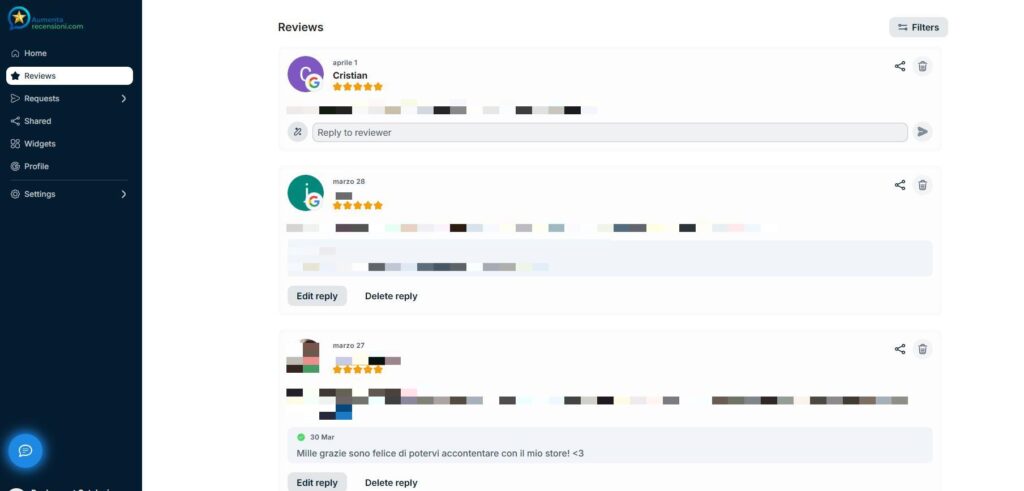
Aumentarecensioni.com offers a specialized platform designed specifically for small and medium-sized Italian businesses that want to systematize the collection and management of Google reviews.
Distinctive features:
Customizable automated campaigns: Create sequences of emails and SMS that automatically trigger after specific events in your business. Personalize messages with the customer’s name, purchase details, and company branding.
Artificial intelligence for responses: AI analyzes the content of each review and suggests appropriate responses, maintaining a professional tone consistent with the brand’s voice.
Website widget: Embed Google reviews directly on your site with customizable widgets that update automatically, enhancing credibility and conversion.
QR code and NFC generation: Create QR codes and set up NFC cards directly from the platform, with tracking to measure the effectiveness of each touchpoint.
Advanced reporting: Analyze trends, identify recurring issues, and measure the impact of reviews on the business with intuitive dashboards.
Guaranteed compliance: All processes adhere to Google’s guidelines, protecting your profile from penalties.
The platform integrates seamlessly with existing systems and requires minimal setup, allowing even those without technical skills to get started immediately.
Responding to Reviews: Strategies and Best Practices
Responding to all reviews, both positive and negative, is as crucial as collecting them. Responses demonstrate that the business is attentive, professional, and cares about the customer experience. [3]
Why Responding Is Essential
Responses to reviews serve three strategic purposes:
Building trust with potential customers: Consumers read responses as much as the reviews themselves. Professional and thoughtful responses enhance the business’s credibility.
Improving SEO ranking: Google considers engagement as a signal of relevance. Businesses that respond regularly receive a boost in local ranking.
Transforming negative experiences: A well-formulated response to a negative review can change perceptions and demonstrate commitment to customer satisfaction.
Learn more why responding to reviews always helps your business.
How to Respond to Positive Reviews
Positive reviews deserve genuine responses that strengthen the relationship with the customer and encourage others to leave feedback.
Elements of an effective response:
- Personalized thank you: Use the customer’s name and refer to specific details mentioned in the review
- Confirmation of positive points: Acknowledge the aspects appreciated by the customer
- Invitation to return: Conclude with a warm invitation to visit the business again
- Conciseness: Keep the response concise (50-100 words)
Example:
“Thank you very much, Laura! We are happy that you enjoyed our fresh pasta and the welcoming atmosphere. Our chef will be thrilled to know that you liked the truffle ravioli so much. We look forward to seeing you soon to try the new dishes on the autumn menu!”
Managing Negative Reviews Professionally
Negative reviews represent opportunities to demonstrate professionalism and commitment to improvement. Effective management can turn an unhappy customer into a promoter of the business.
Fundamental principles:
Respond quickly: Within 24-48 hours of posting. Timeliness shows attention and concern.
Stay calm: Never be defensive, sarcastic, or aggressive, regardless of the tone of the review.
Acknowledge the issue: Validate the customer’s feelings before offering explanations or solutions.
Take it offline: Provide direct contact (email, phone) to resolve the situation privately.
Propose concrete solutions: Offer specific remedies when appropriate.
Example of response to a negative review:
“Dear Marco, we are very sorry for the negative experience you had with our service. The delay in delivery is unacceptable, and we understand your frustration. We would like to personally resolve the situation. Please contact us at [email] or [phone] so we can make amends. Thank you for giving us the opportunity to improve.”
For advanced strategies, consult our guide on how to manage negative reviews and how to turn a complaint into a positive review.
Common Mistakes to Avoid in Review Collection
Even with the best intentions, many businesses make mistakes that reduce the effectiveness of their review collection efforts or, worse, violate Google’s guidelines.
Technical and Strategic Mistakes
Making the process too complicated: Asking customers to manually search for the business on Google drastically reduces the response rate. Always provide a direct link or a QR code.
Asking at the wrong time: Requesting reviews immediately after purchase, before the customer has used the product or service, leads to low response rates and superficial reviews.
Not segmenting requests: Sending the same generic message to all customers ignores the differences in their experiences. Personalize based on the type of service or product purchased.
Ignoring negative reviews: Not responding to negative reviews signals disinterest and damages the reputation more than the review itself.
Responding too slowly: Waiting weeks to respond reduces the positive impact and makes the business seem inattentive.
Using overly obvious templates: Identical or nearly identical responses to different reviews appear automated and insincere.
Violations of Guidelines
Filtering requests: Asking for reviews only from customers who expressed satisfaction violates Google’s policies and creates an artificially positive profile that consumers recognize as suspicious.
Directly incentivizing: Offering discounts, freebies, or other benefits in exchange for reviews is explicitly prohibited and can lead to the removal of reviews or penalization of the profile.
Writing reviews for oneself: Creating fake accounts or asking family and employees to leave reviews is easily identifiable by Google and results in severe penalties.
Buying reviews: Using services that sell fake reviews is the most serious violation and can lead to permanent suspension of the Google Business profile.
Threatening legal action: Responding to negative reviews with threats of lawsuits is counterproductive and may violate platform policies.
Measuring and Optimizing Results
Collecting reviews without analyzing the results means missing out on improvement opportunities. Systematic monitoring allows you to identify what works, what needs to be changed, and how to continuously optimize the strategy.
Key Metrics to Monitor
Monthly review volume: Track how many reviews you receive each month. A steady flow is more important than occasional spikes.
Response rate: Calculate the percentage of customers who leave reviews compared to the total requests sent. A rate of 10-15% is considered good for most industries.
Average rating: Monitor the evolution of the average rating over time. Significant fluctuations require immediate investigation.
Response time: Measure how long it typically takes you to respond to reviews. The goal is to stay under 48 hours.
Sentiment analysis: Analyze recurring themes in reviews, both positive and negative, to identify strengths and areas for improvement.
Channel effectiveness: Compare response rates between email, SMS, QR code, and other methods to focus efforts on the most performing channels.
A/B Testing to Optimize Requests
Systematically testing different variables continuously improves results:
Email subject: Test variants like “Your opinion matters” vs “Can you help us in 60 seconds?” to identify what generates more opens.
Timing of sending: Test requests at 24 hours vs 48 hours vs 72 hours after purchase to find the optimal time for your industry.
Message length: Compare short messages (2-3 sentences) with more detailed messages to see what converts better.
Call-to-action: Experiment with different buttons: “Leave a Review” vs “Share Your Experience” vs “Help Other Customers”.
Personalization: Measure the impact of different levels of personalization (name only vs name + purchase details vs name + details + personal reference).
Implement only one test at a time to isolate the effect of each variable and collect sufficient data (at least 100 requests per variant) before drawing conclusions.
FAQ: Frequently Asked Questions about Google Reviews
How many reviews are needed to be competitive?
The number depends on the industry and local competition. Analyze the top 5 competitors in your area and aim to exceed their average. Generally, 50+ reviews represent a credibility threshold for most industries.
Can I remove unfair negative reviews?
You can report to Google reviews that violate guidelines (offensive content, spam, conflicts of interest). Google only removes reviews that clearly violate policies, not simply because they are negative. Most legitimate negative reviews cannot be removed.
How long does it take to see results?
With a structured system, you should see an increase in review volume within 2-4 weeks. Improvements in local SEO ranking typically require 2-3 months of consistent collection.
Is it better to have many reviews with an average rating or a few with 5 stars?
Many reviews with ratings of 4.3-4.7 are generally more credible and perform better than a few reviews with a perfect 5.0 stars. Consumers are suspicious of profiles with only perfect reviews.
What to do if a competitor posts false negative reviews?
Immediately report suspicious reviews to Google providing specific details. Document any evidence (fake accounts, suspicious patterns). In the meantime, focus on obtaining more authentic reviews to dilute the impact.
Can I ask customers to change negative reviews?
You can privately contact the customer to resolve the issue and, if the situation is satisfactorily resolved, you can kindly ask if they would be willing to update the review. You cannot offer incentives for the change.
Do anonymous reviews have the same value?
Google shows all reviews, but those with complete profiles and photos tend to have more credibility in the eyes of consumers. However, anonymous reviews also contribute to the overall rating and positioning.
How often should I ask the same customer for reviews?
For repeat purchases, wait at least 3-6 months between requests. For ongoing services, ask for reviews after significant milestones rather than at fixed intervals.
Do reviews also influence Google Ads campaigns?
Yes, the rating and number of reviews influence the Quality Score of local ads and can improve the CTR (click-through rate) of campaigns, reducing the cost per click.
What should I do if I receive a review that contains false information?
Respond publicly by politely correcting the incorrect information with specific facts. Avoid accusatory tones. If the review violates Google’s policies (defamation, harmful false information), report it for review.
Can I transfer reviews from other platforms to Google?
No, it is not possible to transfer reviews between platforms. Each review must be left directly on the specific platform. However, you can ask customers to leave reviews on multiple platforms.
Do responses to reviews influence SEO ranking?
Yes, Google considers engagement as a positive signal. Regularly responding to reviews can improve local ranking, as well as build trust with potential customers.
Conclusion: Building a Sustainable Review Collection System
Increasing reviews on Google requires a systematic approach that combines technology, strategic timing, and authentic communication. Businesses that achieve the best results do not rely on sporadic efforts but integrate review collection into their daily operational processes.
Immediate steps to implement:
- Create your direct link to the Google Business profile and start using it in all communications with customers
- Generate QR codes to be strategically placed in your physical location or on delivery materials
- Set up automated emails that trigger 2-3 days after each purchase or service
- Train staff to mention reviews during customer interactions
- Set notifications to respond to all reviews within 24-48 hours
- Monitor results weekly to identify what works and what needs optimization
For small and medium-sized businesses that want to fully systematize the process without dedicating weekly hours to manual management, aumentarecensioni.com offers a comprehensive solution with advanced automation, AI assistance, and detailed analytics.
Review collection is not a project with an end date, but a continuous process that progressively builds the online reputation of the business. Start today with the simplest strategies and gradually add complexity as the system matures.
Google reviews represent one of the most valuable assets for any local business in 2026. Investing time and resources in their collection and management yields measurable returns in terms of visibility, credibility, and ultimately, revenue.