
An Indispensable Tool for Attracting New Customers
Google reviews are today one of the most powerful tools for small businesses and professionals who want to build trust and attract new customers. Most consumers read online reviews before choosing a local business, and a Google My Business profile with positive reviews can significantly increase visibility in local search results. Actively managing Google reviews is no longer optional: it is a competitive necessity for those who want to grow in 2026.
Key Points
- Google reviews directly influence consumer purchasing decisions and local visibility in search engines
- An optimized Google My Business profile with positive reviews improves ranking in Local SEO
- Responding to all reviews (positive and negative) demonstrates professionalism and customer care
- Authentic reviews build trust more than any traditional advertising
- Requesting reviews from satisfied customers should become part of the business routine
- Negative reviews, if managed correctly, can turn into opportunities
- The quantity and frequency of reviews matter as much as the average rating
- Monitoring and analyzing reviews provides valuable insights to improve products and services
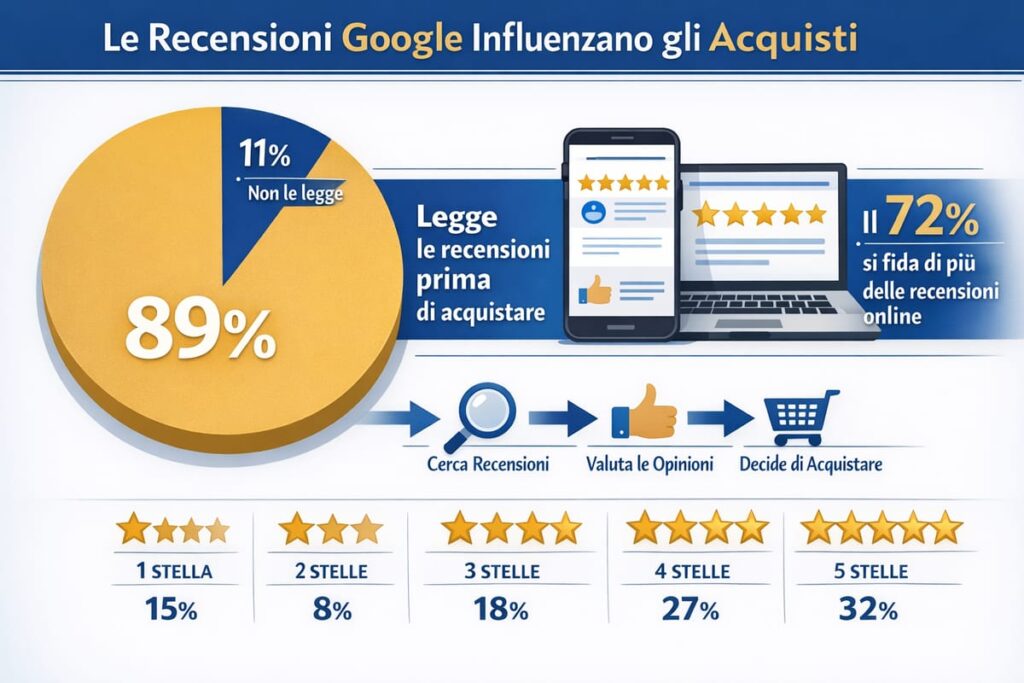
Why Are Online Reviews So Important for Small Businesses?
Online reviews have become the digital word-of-mouth of 2026. Consumers trust the opinions of other customers almost as much as the advice of friends and family, and this is especially true for local small businesses competing with larger chains.
When a potential customer searches for “restaurant near me” or “plumber Milan,” Google displays results with star ratings prominently visible. This first impression can determine whether someone clicks on your profile or moves on to the next competitor.
The Concrete Benefits of Google Reviews
Increased visibility: Google rewards businesses with recent and numerous reviews by ranking them higher in local search results. This means more organic traffic without spending on advertising.
Immediate credibility: A profile with 50+ reviews and an average of 4.5 stars immediately communicates that you are a reliable business. New customers feel more confident choosing you.
Free feedback: Reviews tell you what works and what doesn’t in your business. They are a source of information that you would otherwise have to pay for through surveys or market research.
Competitive advantage: If your competitors have few reviews or a low rating, your positive reviews give you an immediate and measurable advantage.
Who Benefits Most from Google Reviews?
- Restaurants and bars: where reputation is everything
- Professionals (lawyers, accountants, consultants): who need to build trust even before the first meeting
- Retail stores: competing with e-commerce
- Local services (plumbers, electricians, hairdressers): where customers seek reliability
- Accommodation facilities: hotels, B&B, vacation homes
- Medical and dental practices: where trust is essential
Common mistake: thinking that reviews only matter for consumer-facing businesses. Even B2B professionals benefit from reviews because business decision-makers search online before contacting a supplier.
How Google Reviews Influence Local SEO
Google reviews are one of the three main factors that determine ranking in Google’s Local Pack (the three results with a map that appear at the top of the page). The other two are relevance and distance, but reviews weigh heavily.
Google uses various signals from reviews to determine ranking:
- Quantity of reviews: the more you have, the better
- Average rating: obviously, higher stars help
- Frequency: recent reviews count more than older ones
- Diversity: reviews from verified and active Google accounts carry more weight
- Content: detailed reviews with relevant keywords help with ranking
The Connection Between Reviews and Conversions
It’s not just about appearing in search results. Reviews directly influence the conversion rate:
- A business with 4+ stars has a significantly higher click-through rate compared to one with 3 stars or less
- Customers are willing to pay more for services with excellent reviews
- Detailed reviews that mention specific aspects (quality, speed, courtesy) convince undecided customers
Rule of thumb: if you have fewer than 10 reviews, focus first on quantity. After the first 20-30 reviews, quality and management of reviews become more important than just the number.
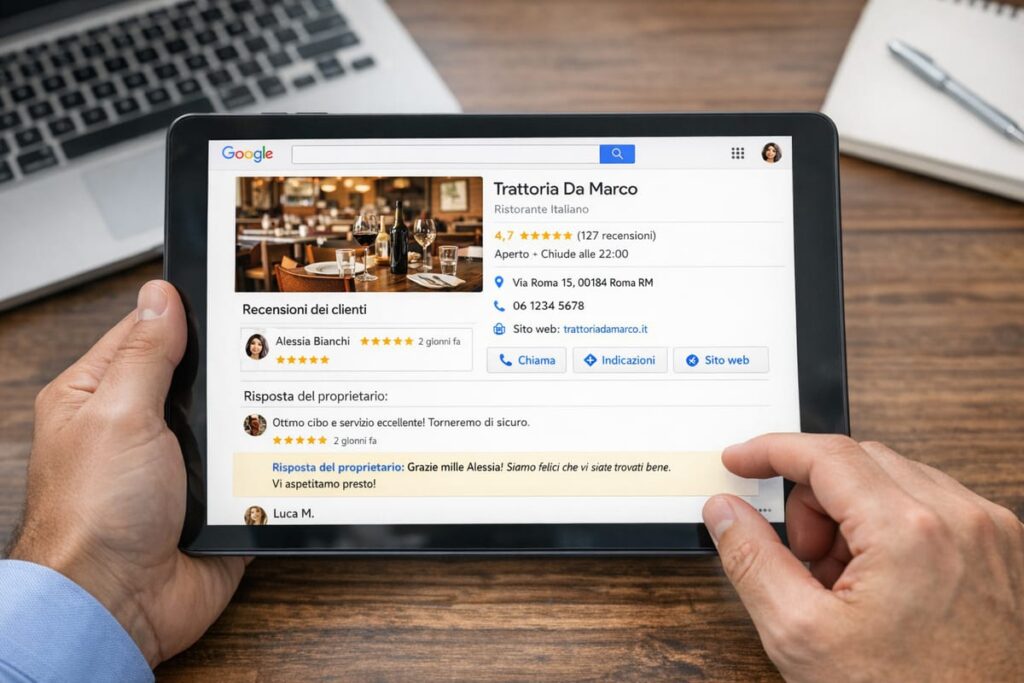
How to Get More Google Reviews from Your Customers
Getting reviews requires a systematic approach. Satisfied customers rarely leave reviews spontaneously, not because they don’t want to, but simply because they don’t think of it or don’t know how to do it.
Effective Strategies for Requesting Reviews
Ask at the right time: the ideal moment is right after a positive experience. For a restaurant, it might be at the end of the meal. For a professional, after successfully completing a project.
Make the process simple: create a direct link to your Google My Business profile that customers can click to leave a review. You can find this link in your Google My Business panel under “Get more reviews”.
Use multiple channels:
- Follow-up email after purchase or service
- SMS with direct link (very effective for local businesses)
- QR codes printed on receipts, business cards, or displayed in-store
- Direct verbal request (often the most effective)
Personalize the request: instead of a generic message, explain why reviews are important for your small business. Customers are more likely to help when they understand the impact.
Example of an Effective Request
“Hi Marco, thank you for choosing our studio for your tax consultation. If you are satisfied with the service received, I would really appreciate it if you could take 2 minutes to leave a review on Google. For a small business like ours, customer reviews make a huge difference. Here is the direct link: [link]. Thank you very much!”
What NOT to Do
❌ Do not offer incentives: Google explicitly prohibits offering discounts, freebies, or other incentives in exchange for reviews. You risk penalties.
❌ Do not ask only for positive reviews: you must ask for honest reviews, not just positive ones. Filtering reviews is against the policies.
❌ Do not create fake reviews: Google is getting better at identifying them and the consequences can be severe (removal of the profile).
❌ Do not be pushy: one or two requests are fine, but bombarding customers is counterproductive.
How to Respond to Google Reviews (Positive and Negative)
Responding to reviews is just as important as getting them. It shows that you are active, that you care about your customers, and that you are professional in handling feedback.
Responding to Positive Reviews
Even though it may seem less urgent, responding to positive reviews is essential. Thank the customer by name (if possible), mention something specific from their review, and invite them to return.
Example of a response to a positive review:
“Thank you so much, Laura! We are happy that you enjoyed our fresh pasta and the cozy atmosphere. Our team works every day to provide an authentic experience. We look forward to seeing you soon to let you try our new truffle ravioli!”
Benefits: future customers see that you are attentive and engaged. Additionally, your responses appear in search results and can contain useful keywords.
Managing Negative Reviews
Negative reviews are inevitable, even for the best businesses. What matters is how you handle them. A professional response to a negative review can actually improve your reputation.
Steps to respond to negative reviews:
- Breathe and wait: do not respond immediately if you are angry or defensive
- Thank for the feedback: even if you disagree, acknowledge that the person took the time to write
- Apologize if appropriate: if there was a mistake on your part, admit it
- Explain briefly: provide context if necessary, but without being defensive
- Offer a solution: propose to resolve the issue offline
- Maintain professionalism: always, even if the review is unfair
Example of a response to a negative review:
“Dear Mr. Rossi, we are very sorry for the negative experience you had at our restaurant. The wait time you described does not reflect our usual standards. That evening we had an unforeseen issue in the kitchen that caused delays. We would appreciate it if you could contact us directly at 333-1234567 to allow us to make it right. Best regards, Marco – Owner”
When and How to Report Inappropriate Reviews
Not all negative reviews need to be accepted. Google allows you to report reviews that violate policies:
- Fake or spam reviews
- Offensive or discriminatory content
- Conflicts of interest (competitors leaving negative reviews)
- Off-topic reviews (talking about another business)
- Illegal content
Reporting process: click on the three dots next to the review and select “Report as inappropriate”. Google will evaluate the report, but the process may take days or weeks.
Important note: Google only removes reviews that clearly violate policies. A negative but honest review will not be removed, even if you think it is unfair.
Creating a Google Review Management Strategy
For small businesses and professionals, managing reviews cannot be a casual activity. It requires a systematic approach that becomes part of the business routine.
Components of an Effective Strategy
1. Constant Monitoring
- Check new reviews at least 2-3 times a week
- Set up email notifications from Google My Business
- Use monitoring tools if you manage multiple locations
2. Response Time
- Goal: respond within 24-48 hours
- Negative reviews require priority response
- Positive reviews also deserve timely responses
3. System for Requesting Reviews
- Identify key moments in the customer journey
- Prepare request templates (but customize them)
- Train staff to ask for reviews in person
- Automate where possible (post-purchase emails)
4. Analysis and Improvement
- Read all reviews to identify patterns
- What is praised most often? Emphasize it in marketing
- What recurring issues arise? Resolve them operationally
- Track the evolution of the average rating over time
Monthly Checklist for Review Management
✅ Check the total number of reviews and the star average
✅ Ensure you have responded to all reviews of the month
✅ Analyze recurring themes (positive and negative)
✅ Update the Google My Business profile with new photos or information
✅ Plan the request for reviews for the next month
✅ Train or update the team on best practices
✅ Compare your metrics with main competitors
Useful Tools for Managing Reviews
| Tool | Main Function | Ideal For |
|---|---|---|
| Google My Business App | Monitoring and direct response | Single businesses, mobile management |
| Google Alerts | Notifications when you are mentioned online | General reputation monitoring |
| Google Sheets | Manual review tracking | Small businesses, limited budget |
| BrightLocal | Multi-platform dashboard | Professionals with multiple locations |
| ReviewTrackers | Advanced analysis and reporting | Businesses wanting in-depth insights |
Choose based on: if you manage a single location and have a limited budget, the free Google My Business app is sufficient. If you have multiple locations or want more sophisticated analysis, consider paid tools.
Optimize Your Google My Business Profile to Maximize Reviews
Google reviews do not exist in a vacuum. They are part of your Google My Business profile, and an optimized profile attracts more reviews and converts visitors into customers better.
Essential Elements of an Optimized Profile
Complete and Accurate Information:
- Business name (consistent everywhere online)
- Exact address (crucial for Local SEO)
- Local phone number
- Updated opening hours (including holidays)
- Website and booking link
- Relevant primary and secondary categories
Quality photos:
- Professional cover photo
- Interior and exterior of the business
- Products or services
- Team at work
- Satisfied customers (with permission)
Businesses with photos receive more direction requests and clicks on their website than those without.
Effective description:
- Explain what you do and what makes you unique
- Include keywords naturally (e.g. “fresh fish restaurant in Rome”)
- Mention specialties, awards, years of experience
- Maximum 750 characters, but the first 250 are the most important
Regular posts:
- Google My Business allows you to post updates
- Share offers, events, news
- Posts keep the profile active and engaging
Link Between Optimized Profile and Reviews
A complete and professional profile encourages people to leave reviews because:
- It shows that you are a serious and active business
- It provides context that makes it easier to write a detailed review
- It increases overall trust in your brand
Mistake to avoid: neglecting the profile after creating it. Google rewards regularly updated profiles with better visibility.

Turning Reviews into a Marketing Tool
Google reviews are not just for the Google profile. They are valuable content that you can use throughout your marketing strategy.
Creative Ways to Leverage Reviews
On your website:
- Create a section “What our customers say”
- Use widgets that show Google reviews in real time
- Highlight specific reviews on product/service pages
On social media:
- Share screenshots of particularly positive reviews
- Publicly thank customers who leave reviews
- Create graphics with quotes from reviews
In marketing materials:
- Include the average rating in brochures
- Add testimonials from reviews in presentations
- Use quotes in email marketing
In advertising:
- Mention the Google rating in ads
- “Rated 4.8 stars on Google by over 200 customers”
- This significantly increases the click-through rate
Potential Case Study: Local Restaurant
A small restaurant in Florence implemented a systematic strategy for Google reviews:
Initial situation (January 2025):
- 12 reviews, average 4.1 stars
- Poor visibility in local searches
- No responses to existing reviews
Actions taken:
- Responded to all existing reviews
- Trained staff to ask for reviews from satisfied tables
- Created QR code on the menu and at the cash register
- Sent follow-up emails to customers on the mailing list
- Updated profile with professional photos
Results after 6 months (July 2025):
- 87 reviews, average 4.7 stars
- Consistent appearance in the Local Pack for “restaurant Florence”
- 40% increase in bookings attributed to Google searches
- Improvement in perceived reputation
Key Lesson: consistency pays off. Requesting reviews should become part of the company culture, not a one-time initiative.
Common Mistakes to Avoid with Google Reviews
Even with the best intentions, it’s easy to make mistakes in managing reviews. Here are the most common ones and how to avoid them.
Critical Mistakes
1. Ignoring negative reviews
Many entrepreneurs think that ignoring a negative review will make it “disappear”. In reality, not responding communicates disinterest and can harm more than the review itself.
2. Responding emotionally or defensively
It’s natural to feel attacked by a negative review, but responding with anger or sarcasm only worsens the situation. Future customers will see your response and judge your professionalism.
3. Buying fake reviews
Besides violating Google’s policies, fake reviews are often recognizable (generic language, new accounts, all 5 stars in a short time). The risk is never worth it.
4. Not having a system to request reviews
Relying on customer spontaneity means having few reviews. A systematic process is needed.
5. Only responding to negative reviews
This communicates that you only care when there are problems. Respond to all reviews to show consistent appreciation.
Less Obvious but Important Mistakes
Using identical templates for all responses: customers (and Google) notice if you always use the same words. Personalize each response.
Not monitoring competitor reviews: seeing what customers say about your competitors gives you valuable insights into what the market appreciates or criticizes.
Forgetting to update information: if you change hours, address, or phone number, update your profile immediately. Negative reviews for “found closed” when the profile says open are avoidable.
Not training staff: if your employees do not understand the importance of reviews, they will not ask customers for them and may not behave in a way that deserves them.
Legal Aspects and Google Review Policies
Understanding Google’s rules and the legal aspects of reviews protects you from future problems.
Google Review Policies
Google has clear guidelines on what is allowed and what is not:
Allowed:
- Request honest reviews from customers
- Respond to any review
- Report reviews that violate policies
- Include direct links to your profile to facilitate reviews
Prohibited:
- Offering incentives for reviews
- Writing reviews for your own business
- Asking employees to write reviews
- Creating fake accounts for reviews
- Threatening customers who leave negative reviews
- Publishing offensive, discriminatory, or illegal content
When a Review Becomes Defamation
In Italy, a review can constitute defamation if:
- It contains false statements presented as facts
- It is written with the intent to harm reputation
- It is not based on a real experience
However, personal opinions are generally protected. “The food was terrible” is an opinion. “This restaurant uses expired ingredients” is a factual statement that, if false, could be defamatory.
What to do: if you receive a review that you believe is defamatory, first try to resolve it directly with the customer. If that fails, consult a lawyer before taking legal action. Defamation lawsuits are expensive and can attract negative attention.
Protecting Customer Privacy
When responding to reviews, be careful to:
- Not disclose personal information about the customer
- Not discuss details of specific transactions without consent
- Be particularly cautious with sensitive information (medical, legal, financial)
Problematic example: “Dear Mr. Rossi, we are sorry that the treatment for your condition did not meet your expectations…”
Correct example: “We are sorry that your experience was not positive. Please contact us privately to discuss the situation.”
FAQ: Frequently Asked Questions about Google Reviews
How many Google reviews do I need to be competitive?
It depends on the industry and local competition. Generally, aim to have at least 20-30 reviews to appear trustworthy. Analyze your main competitors and try to have a similar or higher number. Quality (average rating) matters as much as quantity.
Can I remove an unfair negative review?
Only if it violates Google’s policies (false, spam, offensive, off-topic). An honest but negative review cannot be removed, even if you disagree. You can report it, but Google decides whether to remove it. Your best defense is to respond professionally.
How long does it take to see results from reviews?
The effects on Local SEO can be visible in 2-4 weeks after obtaining new reviews. The impact on reputation and conversions is more immediate. The key is consistency: getting reviews regularly over time is more effective than a sudden influx.
Do old reviews still count?
Yes, but recent reviews carry more weight in Google’s algorithm. A review from 3 years ago counts less than one from 3 weeks ago. This is another reason to obtain reviews consistently, not just at the beginning.
What do I do if a competitor leaves false negative reviews?
Report the review to Google explaining that you suspect a conflict of interest. If you have evidence (e.g., the account is linked to the competitor), include it. Respond publicly in a professional manner without directly accusing. If the problem persists, consult a lawyer.
Can I transfer reviews from other platforms to Google?
No, you cannot copy reviews from Facebook, TripAdvisor, or other sites to Google. Each platform keeps its reviews separate. However, you can ask customers to leave reviews on multiple platforms.
Do reviews also influence Google advertising?
Yes, if you use Google Ads for local campaigns, reviews from your Google My Business profile can appear in ads as extensions. A high rating increases the click-through rate of ads.
Should I respond to every single review?
Ideally yes, or at least to most. Responding shows that you are active and attentive. If you have hundreds of reviews, you can prioritize negative ones and those that are particularly detailed, but try to respond as much as possible.
How do I handle reviews in other languages?
If you operate in a tourist or international area, you may receive reviews in English or other languages. Respond in the same language as the review when possible. Use translators if necessary, but have the translation checked to avoid embarrassing mistakes.
Are anonymous reviews valid?
Google does not allow completely anonymous reviews, but users can use nicknames or initials. These reviews count just like the others. Treat them with the same seriousness and professionalism.
Can I edit a review I left as a customer?
Yes, you can edit or delete your reviews at any time. This also applies to your customers: they can change their mind and update their review after seeing your response or after a subsequent experience.
What happens if I temporarily close the business?
Update your Google My Business profile to indicate the temporary closure. Existing reviews remain visible. When you reopen, update the profile again and consider asking for new reviews to show that you are back in operation.
Conclusion: Building a Strong Reputation with Google Reviews
Google reviews are much more than just simple stars on an online profile. They represent your digital reputation, directly influence potential customers’ purchasing decisions, and determine your visibility in local search results. For small businesses and professionals in 2026, actively managing reviews is no longer optional: it is a competitive necessity.
The good news is that you don’t need a huge budget or advanced technical skills. You need consistency, authenticity, and genuine attention to your customers. Every review is an opportunity: to thank a satisfied customer, to resolve an issue, to improve your service, and to show future customers who you really are.
Concrete Next Steps
If you haven’t started actively managing your Google reviews yet, here’s where to start today:
- Claim and optimize your Google My Business profile if you haven’t already. Complete all the information and add quality photos.
- Respond to all existing reviews, starting with the negative ones. This immediately shows that you are active and attentive.
- Create a system to request reviews. Identify the best moment in your customer journey and prepare a message or process to ask for feedback.
- Train your team on the importance of reviews and how to request them naturally and professionally.
- Set a weekly reminder to check for new reviews and respond promptly.
- Analyze reviews monthly to identify patterns and opportunities for improvement in your business.
Remember: every review is the voice of a real customer who chose to take the time to share their experience. Treat it with the respect it deserves, and you will build an online reputation that will become one of your most valuable assets.
Your online reputation is built one review at a time. Start today, be consistent, and you will see results over time. The small businesses and professionals who excel in managing Google reviews in 2026 are not those with the biggest budget, but those who have understood the value of authenticity and customer relationships.